4. Euclid uses too many databases to store data that are not compatible at all. To find correlations, information must be printed off and consolidated and analyzed by the interested parties. Often, the appropriate reports cannot even be accessed by the individuals who should be able to see the data. For example, if a teacher is interested in which students are receiving the most referrals to the office, he or she must survey the other teachers to get their paper copies of referrals. There is a database that stores referral information; however, this database can only be accessed by administrators and secretaries, who often cannot look up information on repeat offenders because there is no report in that information system to provide that data.
5. Data is collected constantly; however, it is difficult to perceive which data is most important. Data collection is becoming more useless as teachers are inundated with information that has little effect on their current situation. For example, we have spent several staff meetings looking at behavioral referrals from 2005-06, but we cannot look at the behavior referrals from this year because that data is not accessible to us. If the current building climate is a priority, then statistics from students who are currently seniors at the high school is completely void. Therefore, data must be pertinent to a current situation in order to have relevance to decision making.
6. I can access student grades that I have assigned from the past two years. Also, I can access achievement test scores for my current students from all previous years. Finally, I can see student records for all Forest Park students by accessing the paper files. The past achievement test scores are extremely helpful as I prepare my students for the current year's test. I can see which students need more targeted instruction and which ones need more challenges. It would be helpful to access behavioral data in order to understand which students need more behavioral interventions. I can only go by word of mouth to access prior history of students. Often this way of getting background information is subjective because it comes from teachers who may not like the student.
7. The MIS is called InfoWeb. I am able to access certain important information and databases from this system, such as students' grades and test scores, district news, seniority lists, phone extensions, and faculty manuals. This system is okay, but not the most convenient. We are able to access it from home which is convenient. However, as I stated earlier, this system lacks access to databases such as professional development hours, IPDP's, and student behavior statistics. If these systems could be added, the databases would be more compatible and convenient.
http://infoweb.euclid.k12.oh.us/
Wednesday, October 21, 2009


Monday, October 19, 2009
Data and Information Systems
1. At my school, there is a large amount of data collected on a daily, weekly, monthly, and yearly basis. Here are some of the examples of data collected by teachers, principals, and other staff members: achievement test scores for each student and each test taken in each grade level, quarterly grades, attendance, tardies, number of behavioral referrals, number of in-school suspensions, number of out of school suspensions, number of expulsions, parent contact logs, parent meeting logs, teacher attendance, teacher professional development hours, student educational records including histories of abuse, testing, counseling, repeating grades, etc, book assignments, teacher evaluations, etc.
2. Much of the important data such as grades and OAT scores are kept in the district's WebSys database, which is accessible from home or school with the proper log-in information. Behavioral referrals and other data are kept in both paper form and are input into a separate database which is not accessible to teachers. Student records, book assignments, and teacher evaluations are only in paper form and are locked in the office. Parent contact logs are kept in electronic or paper form by each teacher. Professional development information is kept in a database by the district.
3. The data is managed by many individuals dependent on the category. Teachers record grades and parent contact logs and can access grade and test score databases. Secretaries and principals can access behavior related data. Any certified staff member can access the paper records of students' histories. Administrators in the school and in the central office are in charge of data regarding teachers' development and evaluations, and teacher/student attendance.
2. Much of the important data such as grades and OAT scores are kept in the district's WebSys database, which is accessible from home or school with the proper log-in information. Behavioral referrals and other data are kept in both paper form and are input into a separate database which is not accessible to teachers. Student records, book assignments, and teacher evaluations are only in paper form and are locked in the office. Parent contact logs are kept in electronic or paper form by each teacher. Professional development information is kept in a database by the district.
3. The data is managed by many individuals dependent on the category. Teachers record grades and parent contact logs and can access grade and test score databases. Secretaries and principals can access behavior related data. Any certified staff member can access the paper records of students' histories. Administrators in the school and in the central office are in charge of data regarding teachers' development and evaluations, and teacher/student attendance.
Sunday, September 27, 2009
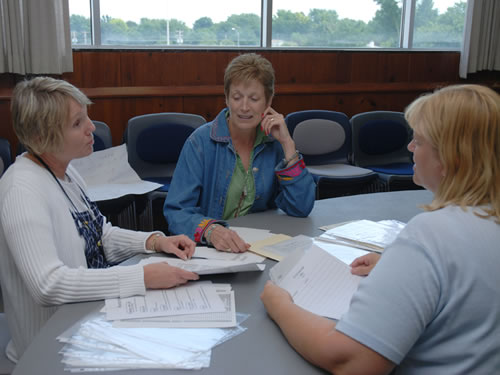

Effective PD and Effective Administrators
According to the articles that I read, there are several factors that influence effective professional development that lead to teacher growth and sustainability in technology. These factors enable professional development that guides teachers to successfully integrate technology to enhance student learning. They are the following:
1. Experiences that are not random and isolated, but rather put in a "situated context". Instead of just showing teachers a certain program or tool, they must be instructed on ideas of where these technologies can be integrated into the curriculum. Teachers can then extend these tools past the initial contexts once proficient in their usage.
2. Ongoing development is important. One session in training is not enough to sustain and impact growth for teachers. Usage of these technologies must be reinforced and coached over time.
3. Availability of tools and support are pertinent. Teachers need to feel comfortable with technology and require support to do so. Technology can often fail; teachers need a resource to call on for trouble shooting. Otherwise, growth and sustainability in professional development will be hindered.
4. Finally, teachers need collegial support groups to truly develop professionally. These professional learning communities can help teachers develop their changing beliefs about technology and provide forums for support and brainstorming. These PLC's can help teachers increase their Content Knowledge, Pedagogical Knowledge, and Pedagogical Content Knowledge.
Effective administrators are those that can create, support, and encourage the above factors. They can provide the physical resources of technology and the personnel to teach teachers how to use them. They set up ongoing professional development opportunities through in-service days and after school sessions. Finally, they facilitate Professional Learning Communities by helping to organize them and creating time in the schedule for them to meet.
1. Experiences that are not random and isolated, but rather put in a "situated context". Instead of just showing teachers a certain program or tool, they must be instructed on ideas of where these technologies can be integrated into the curriculum. Teachers can then extend these tools past the initial contexts once proficient in their usage.
2. Ongoing development is important. One session in training is not enough to sustain and impact growth for teachers. Usage of these technologies must be reinforced and coached over time.
3. Availability of tools and support are pertinent. Teachers need to feel comfortable with technology and require support to do so. Technology can often fail; teachers need a resource to call on for trouble shooting. Otherwise, growth and sustainability in professional development will be hindered.
4. Finally, teachers need collegial support groups to truly develop professionally. These professional learning communities can help teachers develop their changing beliefs about technology and provide forums for support and brainstorming. These PLC's can help teachers increase their Content Knowledge, Pedagogical Knowledge, and Pedagogical Content Knowledge.
Effective administrators are those that can create, support, and encourage the above factors. They can provide the physical resources of technology and the personnel to teach teachers how to use them. They set up ongoing professional development opportunities through in-service days and after school sessions. Finally, they facilitate Professional Learning Communities by helping to organize them and creating time in the schedule for them to meet.
Saturday, September 26, 2009
District wide Inservice Day on Technology
http://euclidschools.org/staff/PresentationProposals.cfm
Above is the link to the Professional Development day based in technology. Teachers can send proposals to present at this district wide conference.
Above is the link to the Professional Development day based in technology. Teachers can send proposals to present at this district wide conference.
Technology Professional Development
Overall, my district does an adequate job of providing development in technology; however, my school does a poor job of providing development.
There are several areas in which I believe my district excels in professional development for technology. First, Euclid schedules one district-wide inservice day every other year that focuses only on technology. Teachers sign up for small group sessions that are conducted by colleagues from throughout the district. Workshops and presentations are available, so that we can see the success that our peers have using technology in their classrooms. In addition, the district has provided each teacher with his or her own laptop. A user manual and training sessions were mandated with the laptops to ensure that we were knowledgable in our usage of the computers. In addition, there are areas in which Euclid is achieving technology integration through professional development. Many workshops are offered throughout the school year and summer that focus on integrating technology in the classroom. However, these workshops are not always advertised, so many teachers don't know what's available to them.
As a school, I believe Forest Park is slumping and failing with professional development in technology. No in-service days are ever used to train teachers to use smartboards, I-pods, cameras/editing programs, or any of the other available technology. Once a year, an administrator from the district conducts a twenty minute review on how to input grades on web based grading system. In addition, the past few years my school has purchased the Study Island website. We received one forty five minute training session over the phone for that program.
In conclusion, professional development is offered, but not made convenient nor widely available to most teachers. It is not surprising that technology is available in my district, but not as prevalently utilized as it should be.
There are several areas in which I believe my district excels in professional development for technology. First, Euclid schedules one district-wide inservice day every other year that focuses only on technology. Teachers sign up for small group sessions that are conducted by colleagues from throughout the district. Workshops and presentations are available, so that we can see the success that our peers have using technology in their classrooms. In addition, the district has provided each teacher with his or her own laptop. A user manual and training sessions were mandated with the laptops to ensure that we were knowledgable in our usage of the computers. In addition, there are areas in which Euclid is achieving technology integration through professional development. Many workshops are offered throughout the school year and summer that focus on integrating technology in the classroom. However, these workshops are not always advertised, so many teachers don't know what's available to them.
As a school, I believe Forest Park is slumping and failing with professional development in technology. No in-service days are ever used to train teachers to use smartboards, I-pods, cameras/editing programs, or any of the other available technology. Once a year, an administrator from the district conducts a twenty minute review on how to input grades on web based grading system. In addition, the past few years my school has purchased the Study Island website. We received one forty five minute training session over the phone for that program.
In conclusion, professional development is offered, but not made convenient nor widely available to most teachers. It is not surprising that technology is available in my district, but not as prevalently utilized as it should be.
Monday, September 7, 2009
Technology
I would have to say that the cell phone is the most important technological invention. It revolutionized communication and inspired the technological trend of convenience and mobility. Also, it is through cellular devices that new technologies are being added. Not only do they act as phones, cells are now hand-held computers, MP3 devices, calendars, calculators, cameras, etc.
The following technologies are essential to my life: the computer, the internet, *cell phones especially text messaging, *Ipod/MP3 players, cars, the television, satellite radio, GPS systems, *social networking websites, email, and *digital photography.
When I get home from school, I check my email and facebook accounts approximately five to ten times before I will go to bed at night. I always listen to satellite radio or my MP3 player when I am driving in the car. Also, I like to unwind by watching television or using youtube.com to look up music videos, television shows, or random clips. Finally, I would be lost if I did not have an internet connection to do a daily sudoku puzzle or crossword puzzle!
Cell phones are used excessively out of the classroom, yet not utilized for communication for school purposes. In addition, students and teachers check myspace and facebook constantly, but don't use these sites for academic reasons. Inherently, these technologies and the internet in general are constantly receiving attention from individuals and the media, but have not really been harnessed for productive reasons.
In ED585, we need to do projects that expose us to the latest technological trends such as blogging, podcasting, creating wikis, and using smartboards. That way teachers will be more apt to use the available resources in the classroom. We need to study ways to appropriately use and REGULATE technologies. It's not enough to learn them, but also we need to know how they can enhance our students' educations by acting as tools, not crutches for learning. I would hope that as a class, we act as a community of learners who can discuss pertinent issues and guide each other with our experiences. For example, I don't know how to use a smartboard, but I am sure that there are members of the class who can teach me. Hopefully, I will be able to reciprocate by teaching them how to use technologies that I am familiar with. The only thing I would avoid in this class is getting side tracked by the uneven distribution of technology. If we are discussing this topic, I would hope that it would not turn into a complaining section, but rather a forum to learn about ways to make technology more accessible to all.
Questions for Dr. Shutkin:
1. What issues in technology are you most interested in?
2. How do you approach issues with technology in your own family? Do you limit internet access for your children? How do you supervise them with the technologies that you have given them?
3. Do you believe that technology is used appropriately in today's world? Or do you believe we have lost a balance in our overreliance on it?
The following technologies are essential to my life: the computer, the internet, *cell phones especially text messaging, *Ipod/MP3 players, cars, the television, satellite radio, GPS systems, *social networking websites, email, and *digital photography.
When I get home from school, I check my email and facebook accounts approximately five to ten times before I will go to bed at night. I always listen to satellite radio or my MP3 player when I am driving in the car. Also, I like to unwind by watching television or using youtube.com to look up music videos, television shows, or random clips. Finally, I would be lost if I did not have an internet connection to do a daily sudoku puzzle or crossword puzzle!
Cell phones are used excessively out of the classroom, yet not utilized for communication for school purposes. In addition, students and teachers check myspace and facebook constantly, but don't use these sites for academic reasons. Inherently, these technologies and the internet in general are constantly receiving attention from individuals and the media, but have not really been harnessed for productive reasons.
In ED585, we need to do projects that expose us to the latest technological trends such as blogging, podcasting, creating wikis, and using smartboards. That way teachers will be more apt to use the available resources in the classroom. We need to study ways to appropriately use and REGULATE technologies. It's not enough to learn them, but also we need to know how they can enhance our students' educations by acting as tools, not crutches for learning. I would hope that as a class, we act as a community of learners who can discuss pertinent issues and guide each other with our experiences. For example, I don't know how to use a smartboard, but I am sure that there are members of the class who can teach me. Hopefully, I will be able to reciprocate by teaching them how to use technologies that I am familiar with. The only thing I would avoid in this class is getting side tracked by the uneven distribution of technology. If we are discussing this topic, I would hope that it would not turn into a complaining section, but rather a forum to learn about ways to make technology more accessible to all.
Questions for Dr. Shutkin:
1. What issues in technology are you most interested in?
2. How do you approach issues with technology in your own family? Do you limit internet access for your children? How do you supervise them with the technologies that you have given them?
3. Do you believe that technology is used appropriately in today's world? Or do you believe we have lost a balance in our overreliance on it?
Sunday, September 6, 2009
How I Learn
I am a funny learner in the sense that I encourage my students to take risks even though I am nervous about taking them myself. I feel more inclined to take risks in learning if several things are in place. First, I will be more inclined to verbally share my thoughts if I have good relationships with other students in the class. This way I won't feel like I am being judged for my perceptions. Next, I like will always be open to try new things or share my ideas when I know my audience is only my teacher. I will always be more adventurous in my endeavors when I am addressing the teacher only. Finally, I am more inclined to try new things when someone demonstrates them for me. For example, I wanted to learn to blog because I had people around me who could answer my questions and model for me how to do each step of the process. This made the set up more conducive to my learning and less scary to approach.
I believe that I am an ideal student. I know my strengths, limitations, and experiences and use them to approach new learning situations. I don't memorize anything. Instead, I work to understand concepts so that I won't forget them. Honestly, I do all my work and believe that it should always be on time. I will not allow myself to give up on a tough concept; I work hard to master all topics set before me. To do this, I often seek extra help, ask my peers to guide me, ask questions to the teacher, and use available resources to help myself. I know that I am a visual learner and learn best when I watch someone model a process for me. Even though I am a reading teacher, I am not the best reader. I often reread articles or directions to ensure comprehension. Also, I appreciate when important concepts or directions are repeated.
The only other thing you should know is that when I get too stressed out from too many obligations, my work sometimes suffers in quality. I will try to communicate this concern to you and am always working on time management.
I believe that I am an ideal student. I know my strengths, limitations, and experiences and use them to approach new learning situations. I don't memorize anything. Instead, I work to understand concepts so that I won't forget them. Honestly, I do all my work and believe that it should always be on time. I will not allow myself to give up on a tough concept; I work hard to master all topics set before me. To do this, I often seek extra help, ask my peers to guide me, ask questions to the teacher, and use available resources to help myself. I know that I am a visual learner and learn best when I watch someone model a process for me. Even though I am a reading teacher, I am not the best reader. I often reread articles or directions to ensure comprehension. Also, I appreciate when important concepts or directions are repeated.
The only other thing you should know is that when I get too stressed out from too many obligations, my work sometimes suffers in quality. I will try to communicate this concern to you and am always working on time management.
Information on me...

My name is Maria Plecnik (please call me Maria), and I am a Cleveland born and raised girl from the east side (Willoughby Hills). If you need to contact me, please email me at mplecnik05@jcu.edu.
I received my bachelor's in education from John Carroll. I graduated in 2006 and have my license in Middle Childhood education in Reading, English, and Math. Currently, I teach in the Euclid City Schools district and teach eighth grade Reading at Forest Park Middle School. I am blessed to be working in such an amazing school with many professional colleagues.
Forest Park Middle School
Anyone who knows me knows one thing about me: I like to work hard to leave something or someone better than before. This applies to my personal and professional aspirations. For example, this summer I worked on building a garage in my backyard because my old one fell down. I didn't hire someone because I wanted to do it myself. My brother and I worked on it for months and now I have a beautiful structure that is much nicer than the old one. Another example is my efforts in school last year. I worked very hard with my students on passing the achievement test and am proud to say that I had a 20% higher passage rate than the district average on the Reading test. This also meant that many students who had not passed tests in previous years were successful in my classroom.
Wednesday, September 2, 2009

Subscribe to:
Posts (Atom)

